Cleveland CBZ vs Smart Sole Full-Face: Beginner Wedge Choice
Compare the 2025 CBZ 56° traditional-groove wedge with the 2024 Smart Sole Full-Face S 58° before buying your first sand wedge.
The buying verdict
Our first trial choice is the CBZ 56° if you want one sand wedge for a mix of pitches, chips and bunkers. Start with the Smart Sole Full-Face S 58° if bunker escapes are the main purchase reason and you want to try its extra-wide sole. These are situation-based choices from manufacturer evidence, not measured winners. Skip both if your current sand wedge works, your real need is a gap wedge, or neither sole suits your firm lies. Buy one useful club before considering a matched set.
Two different designs for the sand-wedge job
These are independent wedge models, not two lofts of the same head. We compare right-handed stock steel builds. The Smart Sole remains an editorial alternative even though its Amazon listing does not pass our exact-pack check. As an Amazon Associate, we earn from qualifying purchases.
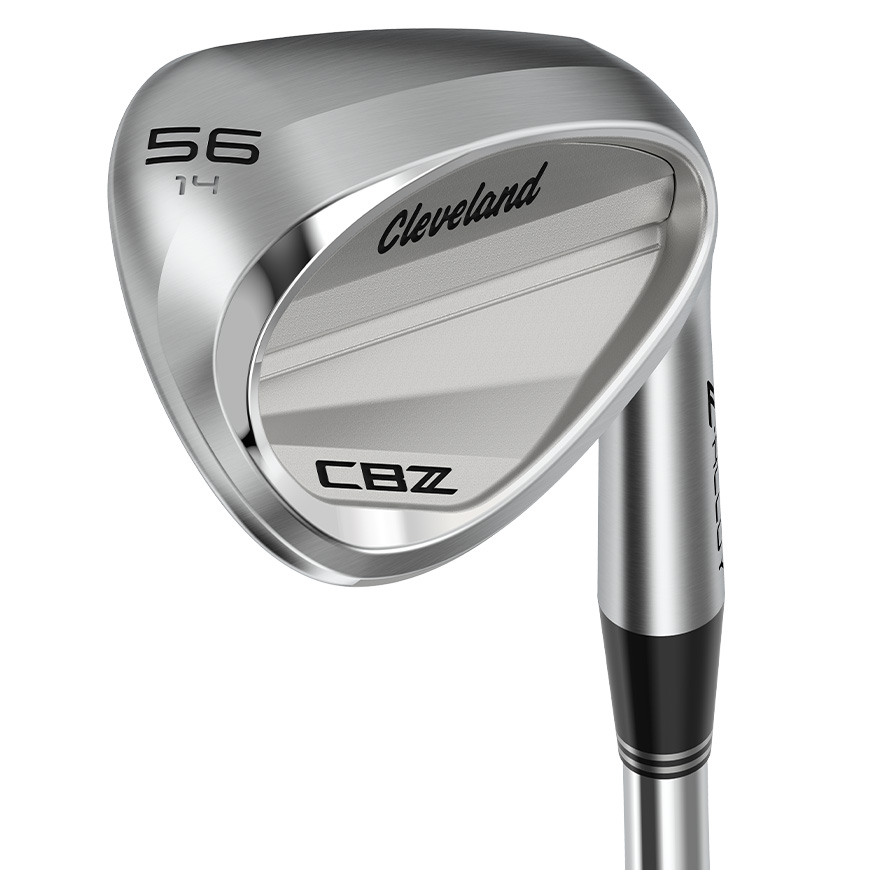
Cleveland CBZ Tour Satin — 56° steel
CBZ (2025), traditional grooves; right hand; 56° loft, 14° bounce, S-shaped sole; Tour Satin. Stock steel build, standard grip, one wedge. Part 11243608. Flex-label note below.
- Consider it if
- The first trial for a mix of pitches, chips and bunker shots, when the 56° carry fits your bag and this cavity-back head feels comfortable.
- Trade-off
- The 14° S-shaped sole is fixed for this build. It may not suit firm lies or shallow delivery; the higher manufacturer price than Smart Sole needs a useful benefit in your trial.
- Skip it if
- You need left hand, graphite, a custom length or lie, less bounce, or already have a sand wedge that performs the same job.
Listing checked 2026-10-24. ASIN: B0FLFR2RHD.

Cleveland Smart Sole Full-Face S — 58° steel
Smart Sole Full-Face (2024), S sand wedge; right hand; 58°; satin finish; extra-wide Three-Tiered Sole. Manufacturer stock steel/Wedge-flex build, standard grip, one club; part 11238898.
- Consider it if
- A bunker-first trial when you want to compare a larger face and extra-wide sole with your current sand wedge. Cleveland positions this S model for greenside sand and shorter chips.
- Trade-off
- The distinctive large head and sole need a real-lie trial. The 58° loft, shaft and length differ from the CBZ; any result compares whole clubs, not sole design alone.
- Skip it if
- You need a lower-loft gap wedge, dislike the head at address, or the wide sole makes contact less predictable on your usual firm turf or compacted sand.
No Amazon purchase link: the checked page says four items but also one included wedge. The comparison uses Cleveland’s single S-wedge specification; confirm the actual pack with a seller before ordering.
What matters before you spend
- •This guide is for a first sand-wedge purchase or a beginner improving a starter set. Selection criteria: the missing shot, turf and sand, carry gaps, comfortable build, total cost and a verifiable order.
- •Use actual lofts and your carry distances. A P, A, G or S marking is not a complete buying specification.
- •A loft gap and a bunker problem are different needs. One new wedge may address one without addressing the other.
- •Our recommendations and practice protocol are editorial guidance based on the sources below. We have not performed hands-on testing of these clubs.
Choose your starting point
Match the row to your situation, then complete the verification step before buying.
| Your situation | Start here | Why | Verify before buying |
|---|---|---|---|
| One club for pitches, chips and bunkers | Trial CBZ 56° first | Our all-purpose starting choice follows Cleveland’s versatile cavity-back positioning. It still needs to earn its place against what you own. | Use its actual 56° traditional-groove, 14° S-shaped build; test all three shots and your normal misses. |
| Repeated bunker failures are the main problem | Trial Smart Sole Full-Face S 58° first | Its extra-wide sole and sand-specific positioning make it a relevant alternative. A bigger head does not guarantee an escape. | Try your normal sand and a firm lie. Confirm one S wedge, not a four-club system or another loft. |
| Pitching wedge only; no reliable bunker option | Demo a 54° or 56° sand wedge | Adds a club to learn greenside and bunker shots with. The cost is another club to practice; skip a blind purchase if the sole does not suit your course. | Try ordinary turf and your usual sand, then check the gap back to your pitching wedge. |
| Pitching and sand wedges; a recurring distance between them | Compare a gap wedge with a controlled partial pitching-wedge shot | A gap wedge can supply a distinct stock carry. Skip it if its normal carry overlaps what you already have. | Compare typical carries and the spread of misses, not the longest shot from each club. |
| Very limited spending room | Keep or borrow first; buy one useful club | Preserves money for instruction and practice. The compromise is fewer stock shot choices; do not buy three clubs just because the unit price is lower. | Set a total ceiling including tax, shipping, grip work and any fitting or return cost. |
| Frequent heavy contact, soft turf or soft sand | Trial a sole that resists digging | Higher-bounce designs are a manufacturer-supported starting point. They do not remove the need to learn contact; skip a purchase based only on a bounce number. | Have a coach or fitter observe delivery and compare actual results from the relevant lies. |
| Firm ground, compacted sand or shallow delivery | Compare sole and bounce alternatives outdoors | Lower-bounce options may suit these conditions. The trade-off can be less help against digging elsewhere; skip the assumption that every beginner needs maximum bounce. | Test both the difficult firm lie and an ordinary lie so you do not optimize for only one shot. |
| Tempted by a 60° wedge or a 52°/56°/60° set | Name the missing shot before buying | A lob wedge adds a high-loft option but also another purchase and practice task. Skip it if a lower-loft club already produces a usable result. | Compare the ordinary miss as well as the best shot; check that the lowest loft fits the pitching wedge. |
Your fitting notes
Do these three clubs cover different distances?
Enter typical measured carry for three neighboring clubs, longest first. Use the same ball and conditions, include ordinary mishits, and keep carry separate from total distance. Try your longest three irons or your PW and next two wedges.
Changing units clears the entries; it does not convert them. Enter values above 0 and no greater than 400.
Adjacent gaps: — / —
This is subtraction of your inputs, not a fitting result or a distance prediction. Bars share a zero baseline and scale to your longest entry. A positive gap alone does not prove useful separation: compare the full shot spreads, flight and landing behavior with your fitter. Overlapping results are a reason to investigate before buying an extra club.
CBZ versus Smart Sole: what actually changes
The CBZ comparison build is the 2025 traditional-groove 56°, not its Full-Face option. The other is the 2024 Smart Sole Full-Face S 58°. Cleveland describes CBZ as balancing cavity-back forgiveness with versatility, and Smart Sole as simplifying short-game shots. We use those manufacturer descriptions to choose trial candidates; they are not independent evidence that either will improve your score.
CBZ is our first all-purpose trial because the decision includes pitches and chips as well as sand. Smart Sole is our bunker-first trial because its S head is specifically positioned for that job. Choose the one that gives you more usable ordinary outcomes across the shots you actually need. Neither earns a blanket beginner, senior or handicap-based win.
The full-face groove pattern on Smart Sole and its extra-wide sole are separate features. Grooves across more of the face do not prove that poor strikes will fly the right distance. A lower price also does not make it the better fit if its head shape or ground interaction bothers you.
First, inventory the wedges already in your bag
Write down the exact iron-set model and generation, each wedge marking and any known alterations. Look up the manufacturer’s loft table. If the club is used or has been bent, ask a club builder to measure it. Do not order a gap wedge while the pitching-wedge loft is still a guess.
Record carry to the first landing point separately from rollout. Use the ball you normally play in a practice setting. If your strikes produce a very wide range, record that honestly: an apparent distance hole may be inconsistent contact rather than a missing club.
Two wedges can be a workable learning setup; three can be useful when the third fills a real gap. The USGA permits up to 14 clubs, including the putter, and allows fewer. That is a ceiling for the whole bag, not a shopping target.
Replacing your irons too? Compare the iron set and its included wedges first so the two purchases cover different jobs.
Choose lofts from your pitching wedge, not from a boxed set
Vokey recommends 4–6° of separation as a fitting starting point. Its fitting process includes distance gapping, so treat that spacing as a shortlist rather than a promised yardage difference. A beginner buying in stages does not need to fill every possible interval immediately.
For illustration, a 44° pitching wedge with a 50° gap wedge and 56° sand wedge has 6° steps. A 46° pitching wedge with 52° and 56° has 6° and 4° steps. These are arithmetic examples to try, not tested setups or a prescription for every player.
With a 42° pitching wedge, jumping straight to 52° leaves a 10° interval. Investigate a closer loft first if the problem is a full-shot gap. If the immediate problem is bunker play and you can afford only one club, a suitable sand wedge may still be the better first purchase; accept that it does not complete your distance coverage.
Choose 50° versus 52°, or 54° versus 56°, by checking the neighboring clubs and comparing carry. Do not replace a useful club merely to make the numbers look evenly spaced.
Fit the sole to the shot and ground
Loft is the face angle; bounce and the shape of the sole affect how the club meets the ground. Vokey’s guidance associates higher bounce with softer conditions and steeper delivery, and lower bounce with firmer conditions and shallower delivery. These are starting tendencies, not a cure for a specific miss.
Grind names describe a manufacturer’s sole designs. Do not assume an S or a Mid label means the same thing across brands. Compare the complete head on turf and sand. A clean strike off a shop mat alone does not establish that the sole works from your usual lies.
If repeated heavy or thin contact continues across suitable demo clubs, spend on an observed lesson or fitting before another wedge. Changing equipment and technique at the same time makes it difficult to know what helped.
What the featured CBZ build does—and does not—offer
Cleveland positions CBZ as a cavity-back, game-improvement wedge. The featured traditional-groove 56° has an S-shaped sole and 14° bounce. Its published stock length is 35.5 inches and lie is 64°. The standard steel shaft is KBS HI-REV 2.0 115, with a standard Golf Pride Tour Velvet 360 grip. These are manufacturer specifications, not our measured results.
Flex-label note: Cleveland calls the stock flex “Wedge”; Amazon displays “Stiff.” We matched Amazon’s part 11243608 to Cleveland’s rendered right-hand, 56°, steel stock configuration with that same SKU. This identifies the build; it does not mean those flex labels are interchangeable across products. Order by the complete configuration and part number.
Consider it when the cavity-back layout and sole work in your trial. Skip this stock build if you need a different hand, shaft, length, lie or sole. One wedge is included; no extra club or accessory bundle is promised. There is no evidence here that paying for this model will lower your score compared with a suitable wedge you already own.
What the Smart Sole S alternative adds
Cleveland’s part 11238898 is the right-hand, steel S sand wedge. Its published specification is 58° loft, 64° lie, 35.25-inch length and D5 steel swing weight, with KBS HI-REV MAX 105 steel and a standard Lamkin Crossline 360 grip. These are manufacturer stock specifications, not a promise that the conflicting Amazon offer delivers that complete build.
Cleveland describes an extra-wide, three-tier sole with additional leading-edge bounce. Its current specification table does not give a numeric bounce for this S model, so we do not adopt the retailer’s 10° field. Compare the actual sole on the course rather than treating an unconfirmed angle as equivalent to the CBZ’s published 14°.
The checked Amazon page selects 58°, right hand, steel and satin, but mixes “Number of Items: 4” with one included wedge and a one-count unit. We have therefore omitted its purchase button. The manufacturer identifies a single S wedge within a four-model family. That establishes the editorial comparison, but does not resolve what the retailer will ship.
When the CBZ premium is worth paying
At the October 24 source check, Cleveland’s displayed stock price for CBZ was higher than Smart Sole’s. That price relationship is a dated observation, not a permanent deal or a performance ranking. Compare today’s exact new-club total, seller and return terms; do not compare a new CBZ with a used Smart Sole offer or a different shaft.
Pay the CBZ premium only when its fit or results on your mix of shots justify it. If a confirmed Smart Sole S build wins the bunker trial without creating a costly miss on ordinary turf, paying more for CBZ would not follow from this evidence. If both tie and your current wedge works, keeping it is the value winner.
With a budget below either suitable new build, borrow or demo first and consider a clearly identified used club with an inspection/return route. Do not buy an uncertain pack or a wrong-handed bargain to meet a budget. Set aside the costs of any grip or fitting work before deciding what you can spend on the head.
Spend according to the job: keep, used, stock or custom
Keep what you own when it supplies a repeatable shot. This costs nothing, but it will not add a missing carry or a different sole. Skip this path when a supervised comparison demonstrates a meaningful fit problem.
A used wedge or a matching set gap wedge can make sense within a tight budget. Ask for clear face, sole and shaft photos, measured loft and length, and alteration history. Include grip replacement and shipping in the quote. Skip an unreturnable bargain when its build or condition remains uncertain; age alone does not tell you how it was used.
A new stock wedge gives you a defined build without paying for unnecessary customization. The compromise is accepting its available dimensions and sole. A premium model earns the extra spend only if your trial shows a useful advantage or it supplies a specification you need.
Custom fitting is a sensible next step when standard lengths feel awkward, weight is uncomfortable or the results conflict. It adds cost and may restrict returns. Ask for the proposed build and total price in writing before ordering, and do not assume a taller player needs the same extension in every club.
A practical comparison before you buy
1. Define the job. Write one sentence such as “a repeatable shot between my pitching and sand wedges” or “a usable escape from our practice bunker.” Bring your current clubs and normal ball model. Ask permission to use the practice area and confirm that demo or return terms allow the intended trial.
2. Establish a baseline. After warming up, alternate five-shot groups with your current sand wedge, CBZ 56° and Smart Sole S 58°, repeating each group once if demos are available. Compare an ordinary pitch, a greenside bunker escape and a firm-lie chip. Use the same balls and targets, and record escapes, usable finishes and short/long misses. These counts are a suggested shopping exercise, not a validated statistical test.
3. Keep the ordinary misses. Record carry, rollout, heavy or thin contact and whether the ball finishes in a usable area. Mark an interrupted attempt separately, but do not delete poor shots simply because they make a club look worse. Change one specification at a time where possible.
4. Repeat on another day or in another relevant lie. A winner on soft sand may not be your winner on firm turf. Buy when the candidate consistently does the stated job within budget. If the result is tied, keep the current club or choose the less costly suitable build; if it is unclear, ask a fitter.
Keep your test ball consistent; our golf-ball buying guide explains a green-to-tee comparison before buying several dozen.
Before-you-buy checklist
- 1Confirm your current pitching-wedge loft, sand-wedge loft and any existing set gap wedge.
- 2Write down the missing shot and typical carries before choosing a gap wedge, CBZ 56° or Smart Sole S 58°.
- 3Check the sole on representative turf and sand, keeping normal misses in the comparison.
- 4Set a complete spending limit, including fitting, tax, shipping, grip changes and return costs.
- 5Put brand, model, generation, hand, loft, bounce, sole, finish, shaft model and flex, length, lie and grip on the order.
- 6Confirm one club versus a set, included accessories, seller, delivery and whether use or customization affects returns.
- 7On arrival, compare the head markings, shaft label, grip and manufacturer part number with the saved order before playing or modifying it.
Questions that usually come next
Do beginners need 52°, 56° and 60° wedges?
No. First check your pitching wedge and any sand wedge already in the bag. Buy a gap wedge only for a useful distance gap and a lob wedge only for an identified shot. A matching set can cost more overall even if each club looks inexpensive.
Should I buy a gap wedge or sand wedge first?
If you have no usable bunker club, try a sand wedge first. If your sand wedge already works but a recurring approach distance falls between it and your pitching wedge, compare a gap wedge against a partial pitching-wedge shot.
Is a 50° or 52° gap wedge better?
Neither is universally better. Check the lofts on both sides and compare your normal carry distances. A lower-loft pitching wedge may call for a closer gap-wedge loft than a prepacked 52° set offers.
Should a beginner carry a 56° or 58° sand wedge?
Choose by useful shots and carry gaps. In this comparison, CBZ 56° is our all-purpose trial and Smart Sole S 58° our bunker-first trial. Their soles and builds also differ, so two degrees alone cannot pick the winner. Do not buy both unless each supplies a distinct shot you repeatedly need.
Which is easier to hit: CBZ or Smart Sole Full-Face?
We have no head-to-head test establishing an easier club for everyone. Start with Smart Sole S for a bunker-focused trial and CBZ for mixed sand-wedge duties, then compare your ordinary misses. Cleveland’s forgiveness descriptions are manufacturer claims, not a guarantee against chunks or thin shots.
Will more bounce stop me chunking chips?
It may help the club resist digging in suitable conditions, but it is not a guaranteed fix. Have someone observe your contact and compare soles on your course conditions before diagnosing the problem from one bad shot.
Is a premium wedge worth it for a beginner?
Only if the complete build supplies something useful in your trial or a specification you need. A usable existing or used wedge can be better value. Spend first on the missing job, a suitable fit and an opportunity to practice.
Can I bend an existing wedge instead of buying another?
Ask the manufacturer or a qualified builder whether that exact head can be adjusted and what the finished specifications would be. Get a quote and check warranty implications. Retest the altered club; do not treat bending as a guaranteed substitute for a different sole or build.
What changes for seniors, left-handed or taller beginners?
Use comfort, delivery and the required build to guide the trial. Age does not select a loft or shaft for you. Left-handed buyers need the correct hand; anyone needing a different length, lie or weight should compare a fitted build instead of accepting this featured stock configuration.
Does Smart Sole Full-Face mean I receive four wedges?
No assumption is safe from the family name alone. Our comparison is the single S 58° model, manufacturer part 11238898. The Amazon page inspected on October 24 conflicts between four items and one included wedge, so we provide no purchase link. Get the exact club count and S-model build confirmed before ordering.
Sources and fact-check notes
We favor manufacturer fitting material for product-specific claims and use independent guides to identify buyer questions. Sources were checked on October 24, 2026.
- Cleveland CBZ specifications and stock configurator
Primary source for head, sole, dimensions, shaft, grip and stock SKU 11243608. Manufacturer positioning is attributed; no independent performance result is claimed.
- Cleveland Smart Sole Full-Face S stock SKU and specifications
Primary source for the single right-hand steel S wedge, shaft, grip, dimensions and three-tier sole. Direct page displayed this build as not available on the review date; its displayed price is a reference, not an in-stock offer.
- Cleveland: choosing between its game-improvement wedges
Manufacturer positioning behind our conditional mixed-shot and bunker-first trial recommendations. No market-wide or measured winner is claimed.
- Cleveland CBZ launch announcement, 2025
Primary generation reference; launch pricing and marketing performance claims are not treated as current offers or our test results.
- Dunlop: Smart Sole Full-Face introduction, 2024
Primary generation reference. Canadian launch pricing is not used for the US buying decision.
- Vokey wedge fitting process
Primary manufacturer guidance for 4–6° starting separation and distance-gapping assessment. The illustrative loft sequences above are editorial examples.
- Vokey bounce and grind guidance
Primary manufacturer guidance connecting bounce with delivery and course conditions, used as a trial starting point.
- USGA: clubs and the 14-club limit
Governing-body guidance: up to 14 clubs, with fewer permitted. There is no required wedge count.