Irons for a 20 Handicap: 3 Models to Compare Before Buying
Compare TaylorMade Qi Max HL, Srixon ZXi4 and Callaway Elyte by flight needs, set makeup and complete fitted cost—then test them against your current set.
The buying verdict
Start your demo with Qi Max HL if low flight or overlapping long irons are the problem. Compare Srixon ZXi4 if you want a hollow-head alternative with a players-inspired appearance and already have a plan for the wedges beyond its 43° PW. Include 2025 Callaway Elyte when its complete fitted quote leaves more budget for fitting and missing clubs. Callaway positions standard Elyte for average-to-faster swings; a lower price does not make it the right low-flight solution. These are candidates for different needs, not tested winners. Keep your current irons if the alternatives do not solve your repeatable problem. Handicap alone does not choose a shaft or justify a new set.
Three models, three reasons to compare
Three models from three brands, with different reasons to demo them. This is a source-based shortlist; we have not tested these irons ourselves. All three linked builds are right-handed steel Regular. Qi Max HL and Elyte include seven clubs, 5–PW/AW; ZXi4 includes six, 5–PW, with no approach wedge. Compare complete fitted cost, not just the set price. Manufacturer head images illustrate the models. Left-handed golfers and anyone fitted into another shaft or custom dimensions should source that exact build. As an Amazon Associate, we earn from qualifying purchases.
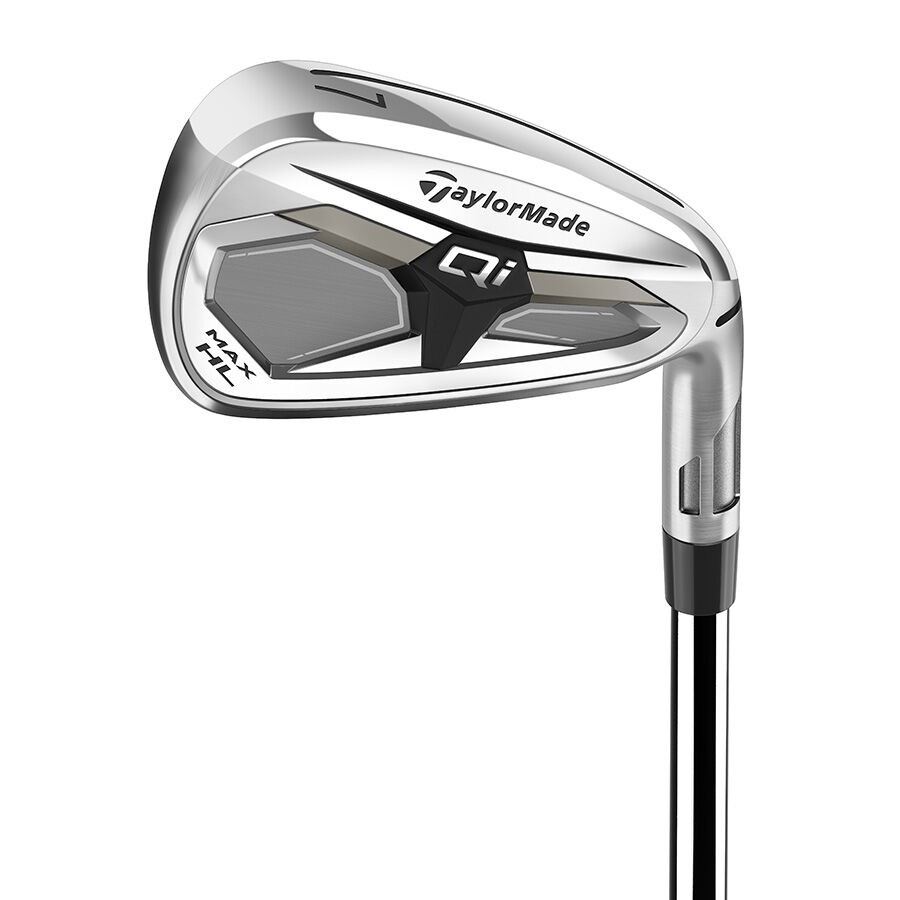
TaylorMade Qi Max HL — steel regular, 5–PW/AW
2026 Qi Max HL; right hand; KBS Max Lite steel, Regular; Satin Chrome; standard stock build and standard grip. One seven-club set: 5, 6, 7, 8, 9, PW, AW. Manufacturer SKU M2133207. Manufacturer head image; lofts below.
- Consider it if
- A player whose demo favors this larger head and higher-launch design, and who can use all seven clubs in this exact build.
- Trade-off
- The larger profile may not suit your eye or turf contact. The included 5-iron is wasted spending if it overlaps your 6-iron; the AW does not complete your greenside setup.
- Skip it if
- You need left hand, graphite, a different flex, custom length or lie, fewer irons, or your existing set performs just as usefully.
Listing checked 2026-10-21. ASIN: B0G2TBP6DC.

Srixon ZXi4 — right hand, steel regular, 5–PW
2025 ZXi4; right hand; KBS Tour Lite steel, Regular; Chrome; standard stock lengths and Golf Pride Tour Velvet 360 standard grip. Manufacturer SKU 11242155. One six-club set: 5, 6, 7, 8, 9, PW. Stock 7-iron 28.5° and 37.25 inches; PW 43°. No AW, sand wedge, hybrid or bag included.
- Consider it if
- A player who prefers this hollow-head design at address and gets useful flight from the fitted build, with existing wedges or budget to cover the gap beyond the PW.
- Trade-off
- Six clubs make the headline price misleading beside seven-club sets. The 43° PW may leave a substantial gap to your sand wedge; the 5-iron still needs to earn its place.
- Skip it if
- You need an included AW, left hand, graphite, another flex or custom dimensions, or the demo produces low flight or overlapping long-iron carries.
Listing checked 2026-10-21. ASIN: B0DT3FFF7X.

Callaway Elyte — right hand, steel regular, 5–PW/AW
2025 standard Elyte, not Elyte X, HL or Max Fast; right hand; steel Regular; standard size and grip; Black/Chrome. One seven-club set: 5, 6, 7, 8, 9, PW, AW. Manufacturer part 4K897268Q2006. Stock 7-iron 29° and 37.25 inches; PW 42°, AW 47°. No sand wedge, hybrid or bag included.
- Consider it if
- A right-handed player comparing a prior-generation Callaway with the other two options, provided this steel Regular build fits and the complete quote makes sense.
- Trade-off
- The 47° AW leaves a different wedge transition from HL’s 50°. Callaway positions standard Elyte for average-to-faster swings; its lower quote cannot compensate for insufficient height in your demo.
- Skip it if
- You need left hand, graphite, a different flex or custom dimensions, struggle to produce useful flight, or the full fitted cost is not competitive.
Listing checked 2026-10-21. ASIN: B0DHWGM4VM.
What matters before you spend
- •This guide helps a golfer around 20 handicap decide whether to replace an iron set, which type to demo and what the final order should contain.
- •Separate iron contact from the rest of your score. A driver penalty or missed short putt is not evidence that you need different irons.
- •Judge the carry pattern, direction and usable flight across the set. The longest 7-iron shot is not a purchase verdict.
- •The recommendations and test sequence are editorial guidance. We have not performed hands-on or launch-monitor testing of the featured set, and promise no handicap or yardage improvement.
Choose your starting point
Match the row to your situation, then complete the verification step before buying.
| Your situation | Start here | Why | Verify before buying |
|---|---|---|---|
| Iron contact is serviceable; most lost shots come elsewhere | Keep your irons and diagnose the costly shots | Preserves your budget for the actual problem. Skip replacement for age or handicap alone; accept that the current set may lack features you prefer. | Record what happened on approach shots over several rounds before booking a demo. |
| Off-center iron contact is a recurring problem | Compare game-improvement heads | A sensible starting category for a forgiveness trial. Larger heads and soles bring visual and turf trade-offs; skip any head that performs worse on your common miss. | Compare normal mishits as well as centered strikes against your own iron. |
| Longer irons fly low or carry nearly the same distance | Try higher-launch builds and a hybrid alternative | Tests the missing flight or distance job. Skip a full long-iron package if the clubs remain redundant; a different label alone is not a solution. | Hit the longest iron you intend to order, not only the fitting 7-iron. |
| Prefer a smaller head and already produce useful flight | Include a compact head in the same comparison | Appearance and feel can matter to your choice. Skip it if ordinary misses become less playable, even when the best shots look excellent. | Retain mishits in the comparison and check carry spread in both directions. |
| Budget would be stretched by a new set | Price a used fitted build or keep the current set | Can reduce the cash needed, but condition, alterations and missing clubs add risk. Skip a bargain with an unverifiable shaft or no workable return policy. | Compare the complete fitted cost, including grips, missing wedges and any needed hybrid. |
| Tall, short, tiring with the current build, or between shafts | Fit length, lie and shaft before choosing a stock listing | A stocked Regular label cannot settle these needs. Custom fitting takes time and may add cost; skip a convenient standard set that differs from your demo. | Get the actual length, lie, shaft model and flex in writing. |
Your fitting notes
Do these three clubs cover different distances?
Enter typical measured carry for three neighboring clubs, longest first. Use the same ball and conditions, include ordinary mishits, and keep carry separate from total distance. Try your longest three irons or your PW and next two wedges.
Changing units clears the entries; it does not convert them. Enter values above 0 and no greater than 400.
Adjacent gaps: — / —
This is subtraction of your inputs, not a fitting result or a distance prediction. Bars share a zero baseline and scale to your longest entry. A positive gap alone does not prove useful separation: compare the full shot spreads, flight and landing behavior with your fitter. Overlapping results are a reason to investigate before buying an extra club.
How to compare these three models fairly
The shortlist is deliberately limited: Qi Max HL tests the need for more loft and a larger profile; ZXi4 supplies a hollow-head alternative; 2025 Elyte lets you compare a prior-generation Callaway quote. Inclusion is not an award. We have no independent head-to-head measurements to call any one the best iron for every 20 handicap.
In card order, the stock 7-irons are 31°, 28.5° and 29°; their pitching wedges are 44.5°, 43° and 42°. Those specifications explain why club numbers alone are a poor comparison. They do not predict your carry, spin or stopping distance. Compare useful flight and the resulting gaps, then price the entire bag change.
TaylorMade describes a larger face and wider sole for Qi Max HL. Srixon describes ZXi4 as a hollow design with a players-inspired shape. Those are reasons to compare appearance and turf interaction in person, not proof that either is better for your misses. The Callaway option is standard 2025 Elyte, not X, HL or Max Fast. Its 47° AW needs a different wedge plan from HL’s 50°; the linked ZXi4 set includes no AW at all.
Compare new, older-stock and used quotes only after matching the number of clubs, shafts, condition and adjustments. An older model is not automatically a bargain. If none gives a repeatable benefit over your existing set, keeping it is the value choice. The carry worksheet helps record distance separation; it does not rank these products.
What the six-club Srixon set leaves out
The verified ZXi4 package stops at PW: 5, 6, 7, 8, 9 and PW. Srixon lists their stock lofts as 23°, 25.5°, 28.5°, 33°, 38° and 43°. Its stock 49° AW is a separate club and is not included in this Amazon build. Test the distance from the 43° PW to your next wedge before deciding whether another club is needed.
Ask for an all-in quote for six irons plus whatever wedge your fitting calls for, then compare it with the seven-club HL and Elyte packages. A separate wedge may let you retain a familiar scoring club, but it can also erase an apparent saving. Do not assume the lowest set price buys the same coverage.
The Amazon part number matches Srixon stock SKU 11242155. Srixon lists KBS Tour Lite steel and a standard Golf Pride Tour Velvet 360 grip for this stock build. Its published 7-iron length is 37.25 inches. Srixon notes that its revised measurement method increased published lengths by about a quarter-inch without changing the actual clubs; have a fitter compare physical length before treating an older specification sheet as evidence of an extension.
Name the iron problem before choosing a category
Keep a brief approach-shot log: club, intended carry, strike location if known, first landing point and the miss that mattered. Separate poor contact from a good strike aimed at the wrong target. Note whether the difficult club is a short iron, every iron or just the longest two.
Use that log to set one buying objective: fewer severe short misses, a more useful long-iron flight, better distance separation or a build you can swing comfortably throughout the session. If you cannot identify a recurring equipment problem, start with an observed lesson or fitting assessment rather than a new set.
Our starting recommendation is game improvement, not an ability restriction. Do not buy a blade as a promise of future improvement, or assume you must leave a forgiving design when your handicap falls. Ask the next set to demonstrate a useful difference now.
What the Qi Max HL example actually includes
TaylorMade positions Qi Max HL as its larger-profile, higher-launch game-improvement option. The company describes a larger face and wide sole intended to support forgiveness. Those are manufacturer design claims, not our measured results or a guarantee that your slice, contact or stopping distance will improve.
For this model, TaylorMade lists lofts of 23.5° (5), 27° (6), 31° (7), 35.5° (8), 40° (9), 44.5° (PW) and 50° (AW). Its stock men’s 7-iron length is 37.25 inches. The steel shaft is KBS Max Lite; choose the actual fitted build rather than treating the Regular label as a handicap category.
The checked Amazon set identifies SKU M2133207. It contains seven irons, with no sand wedge, hybrid, woods, putter or bag included. It is a substantial replacement-set purchase, not a complete starter bag. Compare today’s total with the manufacturer and your fitter before ordering.
Try the sole from your normal turf and assess the head at address. Do not pay for this exact seven-club package if your fitting calls for a 6-iron start or a different shaft. Buying the closest available variant is not equivalent to buying the one you tried.
Budget for the clubs you will actually carry
Write a total ceiling before the fitting. Include the set, fitting charge, tax, delivery, grip or adjustment work, any missing wedge or hybrid, and possible return shipping. Compare quotes with the same club count and build. A lower advertised set price may simply include fewer clubs.
If you can afford only a small change, first investigate the one weak link: a worn grip, an unsuitable long iron or a missing distance between wedges. Get a repair quote before assuming a full replacement is necessary. Do not fund a premium set by removing the practice or instruction budget you planned to use.
For used irons, request clear face, sole and shaft-label photographs for every club. Ask about shaft replacements, extensions, loft/lie alterations, grip condition and the exact return terms. Have a competent shop inspect condition and measure an altered build. Skip the transaction when the seller cannot identify what is being sold.
A newer generation earns its additional cost only if its actual build produces a benefit you value in the comparison. We have no evidence that this particular new set will outperform your existing or a suitable used set for you.
Fit the whole build, including the ends of the set
Callaway’s published iron-fitting protocol considers player goals, shaft selection, length, dynamic lie, grip and set makeup. It uses static measurements alongside observation and asks which is the longest iron the player is comfortable hitting. That supports a fitting process, not a universal flex or length prescription for a 20 handicap.
Ask to compare shaft weight and flex while keeping the head and other settings as similar as practical. Then compare heads in a suitable build. Record each change; otherwise you cannot tell whether the head, shaft or length drove the difference. Age, sex and handicap labels are poor substitutes for this comparison.
At the long end, compare the proposed longest iron with your next iron and a hybrid candidate. If it does not offer a distinct, useful carry and flight, price a shorter iron set. At the short end, write down the actual pitching- and approach-wedge lofts and test them against your retained wedges. Do not assume the letter on a sole specifies a universal loft.
If a new set is longer with the same numbered club, investigate loft and length as well as the flight. Decide whether the new carry pattern is useful after accounting for any extra clubs needed at either end. Raw 7-iron distance alone cannot answer that.
If standard length is in doubt, use our height and wrist-to-floor fitting guide to prepare for the length-and-lie discussion.
Once the iron set is settled, plan the wedges around its actual PW loft instead of buying a familiar three-wedge bundle.
A practical keep-or-buy test to take to the fitting
1. Bring your current irons, normal playing ball and shot log. Tell the fitter your all-in budget and one main objective. Warm up before comparing. Use the same target and conditions; label simulator carry separately from total distance.
2. Compare your mid-iron with two plausible alternatives. As an editorial practice protocol, start with two alternating blocks of five shots per build, with rests. This is a manageable comparison, not a validated sample size or a lab test. Keep ordinary mishits in the record; mark monitor misreads separately rather than quietly deleting poor shots.
3. Save each shot’s carry and direction, and record strike location and comfort. With a launch monitor, ask the fitter to explain launch, spin and landing angle together for your speed and the greens you play. Do not chase a universal internet target. Without reliable carry measurement, use the session to shortlist and arrange a measured fitting before a costly purchase.
4. Test the proposed longest iron and a short iron or wedge before committing to the whole set. Check the transition to your retained hybrid and sand wedge. If a fitting cart cannot provide those clubs, seek a demo or a clearly permitted trial instead of assuming the 7-iron result applies throughout.
5. Repeat the leading option against your own club after a break, then try normal turf if the first comparison was on a mat. Buy only if the benefit addresses your stated problem without an unacceptable new miss or missing-club expense. If results are mixed or fatigue changes the winner, retain the current set and retest another day.
Make the online order match the demo
Write the brand, exact model and generation, hand, every included club, shaft manufacturer and model, flex, length, lie, loft changes and grip specification on the fitting sheet. Check the retailer’s selected variant and final order summary against that sheet. A product photograph or a shared review pool is not proof of the selected build.
Confirm the seller, delivery destination and new-versus-used condition. Read whether a played club can be returned, the time limit, fees and treatment of custom builds before testing a delivered set. Ask how warranty support works for that seller; a listing’s warranty line is not a substitute for applicable terms.
When the clubs arrive, inspect the club count, shaft labels and condition before playing. Have any critical fitted measurements checked if the supplied build is uncertain. Retest when contact, speed, physical comfort or the rest of your bag changes, not simply because a new model launches.
Before-you-buy checklist
- 1I can name the recurring iron problem and explain why replacement, repair or keeping my set is the right response.
- 2I compared the proposed build with my own clubs and retained ordinary mishits in the results.
- 3The longest iron supplies a useful job, and the PW/AW transition fits the wedges I will carry.
- 4The full cost fits my ceiling, including any hybrid, wedge, grip work, fitting and return charges.
- 5My order lists the exact model/year, hand, club count, shaft model/flex, lengths, lie/loft changes and grip.
- 6The selected listing matches the fitting sheet, and I understand seller, condition, trial, return and warranty terms.
Questions that usually come next
Should I compare Srixon ZXi4 with Qi Max HL?
Yes, if both suit the problem you are trying to solve. HL offers a larger-profile, higher-launch design; ZXi4 offers a hollow head with a players-inspired appearance. Their stock 7-irons are 31° and 28.5° respectively. Compare ordinary misses, useful height and turf contact rather than awarding the win to the longer shot. The linked ZXi4 package also lacks the AW included with HL.
Are all three linked sets right-handed, and does Regular mean the same build?
Yes, all three are right-hand steel Regular. Qi Max HL and Elyte contain seven clubs, 5–PW/AW; Srixon ZXi4 contains six, 5–PW. Regular does not promise identical shaft feel or fit across brands. Match the exact shaft and dimensions to your demo. Changing an Amazon selector can change the product and invalidate this check.
Is a six-club iron set better value than a seven-club set?
Compare the complete bag change. The linked ZXi4 set ends at a 43° PW and has no approach wedge. Include the cost of any wedge needed to bridge your measured carry gap, plus fitting and adjustments, before comparing it with a seven-club package. Six can be enough if your existing wedges already cover the required shots.
Is 2025 Callaway Elyte a better-value choice than Qi Max HL?
Only if the fitted build and complete cost work for you. Compare the same seven-club count, then include fitting and any missing wedge or hybrid. Elyte’s stock 7-iron is 29° and its AW 47°, compared with HL’s 31° and 50°. A lower set quote is poor value if you need more useful height or extra clubs to repair the gaps. Test against your current irons before paying.
What irons should a 20-handicap golfer play?
Start the comparison with game-improvement heads, then let your strike pattern and useful flight decide. Trial higher-launch options when longer irons fly low or overlap. A compact head remains an option if it keeps your ordinary misses playable. Keep your current irons when the demo does not justify a change.
What are the best used irons for a 20 handicap?
A used set in the build that fits you is a better target than a particular old model name. Compare complete cost and inspect every club for condition and alterations. If shafts, lengths or missing clubs cannot be verified, skip the apparent bargain. This guide does not endorse an unverified used listing.
How far should a 20 handicap hit a 7-iron?
There is no yardage target in this guide: handicap alone does not specify speed, strike, loft or playing conditions. Measure your typical carry and spread. For buying purposes, a useful flight and sensible gaps to neighboring clubs matter more than matching another golfer’s distance.
Should I buy blades to improve, or a set I can grow into?
Do not make future improvement the justification for a worse result today. Compare the smaller head if you like it, but retain the same standards for misses and distance coverage. Our recommendation is to buy the build that serves your current shots and retest when your needs change.
Should a senior or a 20 handicap automatically use graphite Regular?
No. Compare actual shaft models, weights and flexes with a fitter. Treat fatigue or uncomfortable feel as reasons to investigate the build, not as proof of one material or label. The featured steel Regular set should be skipped if the successful demo used something else.
Should my iron set start at a 5-iron or a 6-iron?
Start with the longest iron that adds a useful carry and flight beyond the next club. Compare a hybrid for that job. If the 5-iron overlaps your 6-iron, price the shorter set plus the required alternative rather than buying seven clubs just because they are bundled.
Does an approach wedge mean I do not need another wedge?
No. In the featured Qi Max HL set, the AW is 50°. Test its full-shot distance and greenside use against the wedges you retain. The seven-club package includes no sand wedge. Buy an additional club only for a shot or gap your current setup does not cover.
Is fitting worthwhile before my swing is consistent?
Use a fitting to check basic suitability and compare realistic misses; you do not need perfect strikes to ask those questions. If results fluctuate too much to distinguish builds, stop short of an expensive order. Instruction and a later comparison may be the more useful next spend.
Can I adjust my current irons instead of replacing them?
Ask a qualified builder to inspect them and quote the specific work. Do not assume every head can accept the desired loft or lie change, or that a reshaft is economical. Compare the fitted result and total repair cost with keeping the set unchanged or buying a suitable replacement.
Sources and fact-check notes
We favor manufacturer fitting material for product-specific claims and use independent guides to identify buyer questions. Sources were checked on October 21, 2026.
- TaylorMade Qi Max HL product specifications
Checked October 21, 2026: lofts, stock length, shaft, head image and direct starting price. The rendered Amazon page identified right-hand steel Regular 5–PW/AW, SKU M2133207. Manufacturer positioning is not independent testing.
- Srixon ZXi4 stock configuration and specifications
Checked October 21, 2026: stock SKU 11242155, right hand, steel Regular, selected 5–PW; KBS Tour Lite, stock grip, lofts, lengths, measurement-method note and model image. Rendered Amazon ASIN B0DT3FFF7X identified the same part number, 2025 model, right-hand steel Regular, Chrome, standard grip, six clubs and an in-stock new offer. The checked price was below Srixon’s configured six-club direct quote. Neither the separate 49° AW nor manufacturer performance promises are presented as included equipment or our test results.
- Callaway Elyte specifications and configuration
Checked October 21, 2026: standard 2025 Elyte identity, lofts, lengths, positioning and model image. Rendered Amazon ASIN B0DHWGM4VM showed right-hand steel Regular, standard size/grip, Black/Chrome, seven clubs 5–PW/AW, part 4K897268Q2006 and an in-stock GolfDirectNow offer. Its checked price was below Callaway’s configured right-hand steel Regular seven-club quote; prices and sellers can change. Amazon labels the shaft Steel; confirm its exact model against your demo before ordering.
- TaylorMade Qi Max HL launch announcement
Primary confirmation of the 2026 generation, larger HL profile and KBS Max Lite steel option. No manufacturer performance promise is presented as a result for the reader.
- Callaway iron-fitting protocol
Primary process reference for goals, length, shaft, dynamic lie, grip and longest comfortable iron. Its model-specific speed and launch tables are not applied as universal targets. Our alternating-shot protocol is editorial guidance, not a Callaway test or an experiment we conducted.